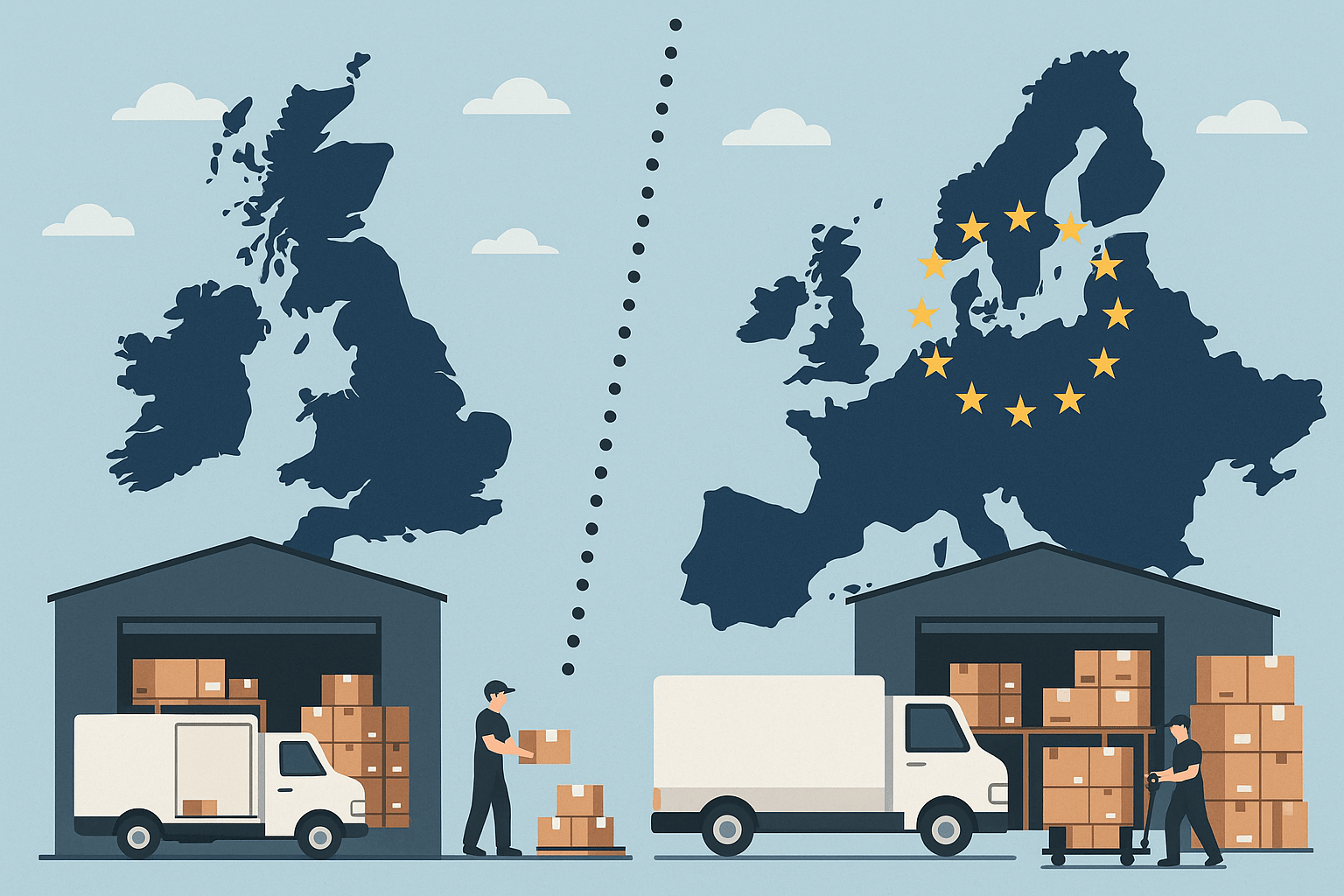
For ecommerce sellers looking to expand internationally, choosing the right logistics setup has become more complex in recent years. One of the most common questions we hear is whether it’s enough to work with a single 3PL Europe provider, or whether a separate warehouse in the UK is necessary.
Since Brexit, the reality is that the United Kingdom and the European Union now operate under two different trade regimes. For online sellers, this change has huge implications for warehousing, order fulfillment, and shipping strategy.
In this article, we’ll break down the main differences between 3PL in the UK and 3PL in the EU, why having two warehouses is often the best choice, and how to decide what setup makes sense for your business.
Why Brexit Changed Everything
Before Brexit, sellers could operate from a single warehouse in the UK and serve customers all across Europe without additional customs paperwork, duties, or VAT complications. That’s no longer the case.
Now, goods moving between the UK and EU are treated as international imports and exports. This creates several challenges for ecommerce sellers:
- Extra duties and taxes: Shipments crossing borders face import VAT and customs duties, driving up costs.
- Delays at customs: Clearance processes slow down delivery times and make it harder to promise fast shipping to customers.
- Administrative burden: Additional paperwork and customs declarations add complexity to daily operations.
Because of these factors, a single 3PL setup—whether in the UK or EU—no longer efficiently serves both markets.
3PL Europe: Serving All EU Countries From One Hub
One of the biggest advantages of using a 3PL Europe provider is that you can serve the entire EU market from a single country. For example, if you warehouse goods in Germany, you can ship to customers in all EU member states without customs duties or border delays.
Additionally, Germany is geographically central, has excellent carrier networks, and offers fast delivery not just within the EU but also to nearby non-EU countries like Switzerland and Norway.
This makes an EU-based warehouse a natural choice if your main customer base is on the continent.
Key benefits of EU-based 3PL:
- Reach 27 EU countries with no duties or customs clearance
- Access to central European shipping routes and carriers
- Ability to serve Switzerland and Norway efficiently
- Simplified VAT compliance under EU rules
However, from an EU hub you cannot realistically serve UK customers anymore. Shipments to the UK will face the same customs hurdles and taxes as shipments coming from outside Europe.
3PL in the UK: Still Valuable for the Local Market
For many brands, the UK remains a key ecommerce market. British consumers are among the largest online shoppers in Europe, and offering fast and affordable delivery is crucial to winning sales.
If you ship orders to UK customers from an EU warehouse, your parcels will face:
- Import VAT and duties upon arrival
- Longer delivery times due to customs checks
- Higher shipping costs compared to domestic UK delivery
This is why a UK-based 3PL is still critical for brands with significant order volume in the British market.
Key benefits of UK-based 3PL:
- Domestic shipping speeds and prices within the UK
- No customs duties or VAT delays for local orders
- Easier returns processing for UK customers
Do You Need Two Warehouses?
For many ecommerce sellers, the best solution is to operate with two 3PL partners: one in the UK and one in the EU. This setup eliminates cross-border duties and allows you to offer local shipping speeds in both regions.
However, whether you should commit to two warehouses depends largely on your business:
- If your sales are balanced between the UK and EU: Two warehouses are almost always worth it.
- If most of your sales are in the EU: Stick with an EU hub (e.g. Germany) and ship to the UK only if volume justifies it.
- If most of your sales are in the UK: Keep operations in the UK only and serve EU customers through cross-border shipping, but expect higher costs and slower times.
Other Differences to Consider
Beyond Brexit-related challenges, there are some practical differences between running operations in the UK and in the EU:
- Carrier networks: Major carriers (UPS, DPD, DHL) operate across both markets, but pricing and service levels differ. EU carriers tend to offer broader international coverage, while UK carriers have stronger domestic focus.
- Returns management: Returns are more efficient when handled locally. UK customers prefer UK returns, and EU customers expect EU addresses.
- VAT and tax compliance: The UK now has its own VAT rules, separate from EU OSS (One-Stop Shop) reporting. This requires separate registrations and accounting if you operate in both regions.
- Inventory allocation: Sellers need to carefully split inventory between warehouses to match demand in each market, otherwise one region may run out while the other is overstocked.
Final Thoughts 3PL Europe
The days of serving all of Europe from a single UK warehouse are over. For ecommerce sellers, the question isn’t whether Brexit changed logistics, it’s how you adapt.
A 3PL Europe provider gives you seamless access to all EU markets, plus efficient delivery to neighbors like Switzerland and Norway. A UK-based 3PL keeps you competitive in Britain by avoiding duties, delays, and high cross-border costs.
For brands with growing international sales, the optimal setup is often two warehouses: one in the EU and one in the UK. For others, focusing on just one side of the channel may be the more cost-effective option.
Ultimately, the right logistics decision depends on your volumes, your customers, and your long-term growth strategy.