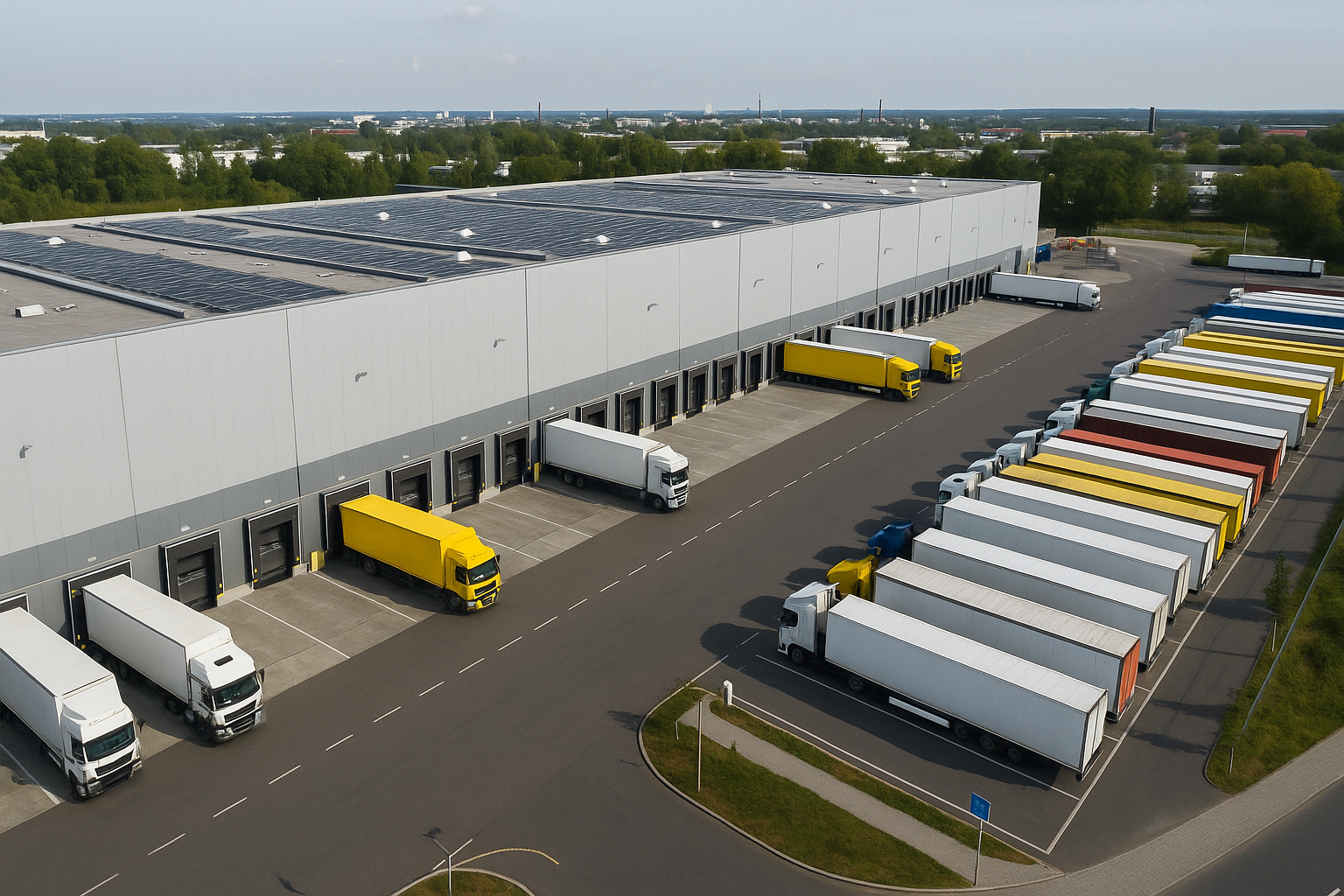
Germany is Europe’s logistics engine. Every year billions of euros in goods pass through the country’s warehouses, cross-dock facilities and distribution networks. Its highways, rail system and airports make it the most central hub for serving the European Union. For international brands this means that choosing a German 3PL can open doors to twenty seven EU markets at once. Yet, despite this clear role, the market structure is not always easy to understand from the outside.
How large is the German logistics sector
The logistics sector in Germany is enormous. Industry sources count more than 70,000 companies active in logistics in a broad sense, from trucking to warehousing to customs brokerage. This makes logistics the country’s third largest economic sector, ahead of industries like finance or energy.
At the European level, Eurostat reports that transportation and storage in the EU generated 1.9 trillion euros of turnover in 2022 with about 1.4 million companies active in the sector. Within this continental picture Germany is by far the largest national market.
How many 3PLs are actually operating
Not all logistics companies are 3PLs. Many firms focus only on transport or operate warehouses for their own use. A true 3PL handles storage, order fulfillment and distribution for other brands. When we filter the German market down to this definition, the number is no longer in the tens of thousands but rather in the low thousands.
Estimates based on industry counts suggest that Germany has several thousand operational 3PLs. Most are small or family owned, often employing fewer than 50 people and serving just a handful of customers. Hundreds are medium sized regional providers. At the very top only a few dozen firms qualify as large scale players with international reach.
Who are the leaders
The giants of German 3PL are global names. They combine worldwide networks with deep local capacity.
DHL Supply Chain is part of DHL Group, which reported 84 billion euros in revenue in 2024.
DB Schenker, owned by Deutsche Bahn, is another heavyweight that consistently ranks among the top contract logistics providers worldwide.
Dachser generated around 8 billion euros in 2024. Rhenus reported 8.2 billion. Fiege, one of the largest family owned groups, posted about 2 billion euros.
Together these companies control a disproportionate share of total revenue. They handle global contracts for automotive, retail, chemicals and e commerce. Yet they coexist with thousands of small providers that keep the system flexible and adaptive.
The role of small and medium providers
Small and medium 3PLs play an essential role in Germany. They cover regional markets, provide sector specific expertise and offer the personal touch that large corporations cannot always deliver. Many of these firms are highly efficient but operate under the radar, often with limited marketing and sometimes only in German.
For international companies trying to enter Germany or the EU this creates a paradox. On one hand the country has an incredibly dense network of logistics providers. On the other hand, finding the right partner that speaks English and understands cross border e commerce can feel challenging.
The language barrier
Germany scores high on English proficiency overall. In the EF English Proficiency Index 2024 the country ranked tenth worldwide. But there is a gap between general skills and business practice.
Many small logistics providers still operate almost entirely in German. Their websites, contracts, invoices and customer support may not be available in English. For international brands this can create friction. A European Commission study already showed that 11 percent of SMEs in Europe had lost contracts because of language barriers.
By contrast, in the United States or the United Kingdom the business language is English by default. This makes it easier for foreign companies to connect with providers. In Germany, the choice of English friendly 3PLs narrows down to the larger players and a limited group of mid sized firms concentrated in the main hubs.
How Germany compares internationally
The United States is the largest 3PL market in the world. Armstrong and Associates valued it at 171.8 billion dollars in 2023. In 2024 the market rebounded with net revenues of 131.5 billion dollars.
The United Kingdom is also a mature market. Logistics UK reported more than 214,000 logistics companies as of 2023. Market analysts estimate the UK 3PL sector between 29 and 39 billion dollars by 2025.
Germany sits between these two models. It is larger than the UK by industrial base and location, but less accessible linguistically. It is smaller in revenue than the US, but strategically essential for any company that wants access to the European Union.
What this means for international brands
For an American or British company looking at Europe, the choice is clear. Germany offers unmatched infrastructure and market access. But navigating its 3PL landscape requires careful selection. Small providers can offer cost effective and flexible solutions, yet communication may be limited. Large providers guarantee professionalism and English service, but often come with higher costs and less flexibility.
The key is to balance scale, service quality and communication. For many brands, the right strategy is to combine the reach of a major German 3PL with the responsiveness of a specialized SME partner.